Can Adults Really Become Fluent in a New Language? What Research Says
Many people believe that learning a new language is something best left to children. It is common to hear statements like, “I’m too old to learn German,” or “Children pick up languages much faster than adults.” While children may have certain advantages, modern research shows that adults are fully capable of becoming fluent in a foreign language. In fact, adults often bring strengths to the learning process that children do not have, including discipline, motivation, life experience, and the ability to understand grammar and learning strategies.
Whether your goal is to work abroad, pursue higher education, travel confidently, or simply challenge yourself intellectually, becoming fluent as an adult is entirely achievable. The key is not age—it is the quality of learning, consistency, and regular practice.
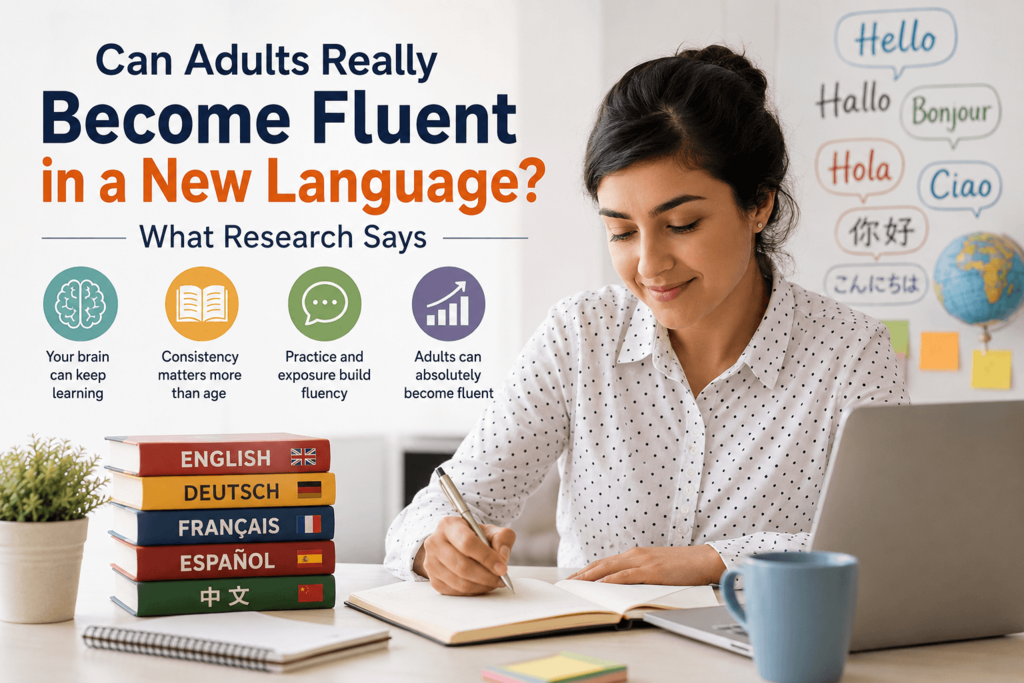
Why Many Adults Believe It’s Too Late to Learn a Language
One of the biggest barriers adults face is not intelligence but mindset. Many people compare themselves with children and assume that because children appear to learn naturally, adults cannot reach the same level.
Research suggests otherwise. While young children may develop native-like pronunciation more easily, adults typically learn vocabulary, grammar, and communication strategies much faster during the initial stages. Adults understand patterns, ask better questions, and can connect new knowledge with previous experiences.
The biggest challenge for most adults is balancing work, family, and personal responsibilities. Unlike children who learn in an immersive environment every day, adults often have limited study time. This makes consistency more important than long study sessions.
What Research Says About Adult Language Learning
Neuroscience has shown that the adult brain remains adaptable throughout life. This ability, known as neuroplasticity, allows people to create new neural connections whenever they learn a new skill. Language learning is one of the most effective ways to stimulate this process.
Researchers have also found that adults benefit from:
- Goal-oriented learning
- Structured lessons
- Regular speaking practice
- Meaningful conversations
- Real-world application
Rather than memorizing long vocabulary lists, successful learners use words immediately in conversations, writing, and listening exercises. This repeated use strengthens memory and improves fluency over time.
Another important finding is that frequent exposure is more valuable than occasional intensive study. Even 20 to 30 minutes of daily practice often produces better long-term results than studying for several hours only once a week.
The Habits Shared by Successful Adult Language Learners
Adults who become fluent usually develop a few consistent habits rather than relying on natural talent.
They Practice Every Day
Daily exposure keeps the language active in the brain. Reading a short article, listening to a podcast, or practicing speaking for just a few minutes each day can significantly improve retention.
They Are Not Afraid to Make Mistakes
Many adults hesitate to speak because they worry about incorrect grammar or pronunciation. However, mistakes are a natural part of language acquisition. Every conversation becomes an opportunity to improve.
They Focus on Communication
Instead of trying to memorize thousands of isolated words, successful learners focus on using complete sentences in real situations. Communicating ideas is far more valuable than knowing complex vocabulary without practical application.
They Learn Through Multiple Methods
Reading, listening, speaking, writing, and interacting with native speakers all reinforce one another. Using different learning methods creates stronger memory pathways.
They Stay Consistent
Fluency is rarely achieved through short bursts of motivation. It is built through months of regular effort and continuous improvement.
How the Indian Institute of Foreign Languages Supports Adult Learners
One interesting observation from the Indian Institute of Foreign Languages (IIFLS) is that adult learners often make remarkable progress when they receive structured guidance and practical speaking opportunities. Over the years, the institute has worked with thousands of students, working professionals, healthcare workers, engineers, business owners, and individuals preparing for international careers. Their experience consistently demonstrates that motivation and consistent practice matter far more than age.
For learners beginning their language journey, resources available on provide useful information about different foreign language programs, career opportunities, and internationally recognized language certifications. Those specifically interested in German can also benefit from the comprehensive guide available which explains learning stages, study strategies, and practical preparation tips.
Rather than emphasizing memorization alone, experienced instructors encourage learners to develop listening, speaking, reading, and writing skills together. This balanced approach helps build confidence gradually and prepares students to communicate effectively in academic, professional, and everyday situations.
Practical Tips for Adults Who Want to Become Fluent
If you are serious about learning a new language, consider these practical strategies:
Set realistic goals. Instead of aiming for fluency within a few months, focus on achieving small milestones such as introducing yourself, ordering food, or holding a short conversation.
Speak from the beginning. Waiting until your grammar is perfect only delays progress. Speaking early builds confidence and reveals areas that need improvement.
Immerse yourself. Listen to music, watch films, read news articles, and follow social media content in your target language. Constant exposure helps your brain recognize patterns naturally.
Review regularly. Revisiting vocabulary and grammar after increasing intervals strengthens long-term memory more effectively than repeated cramming.
Find a learning community. Practicing with teachers, classmates, or conversation partners keeps motivation high and provides valuable real-world experience.
Beyond Fluency: The Long-Term Benefits
Learning a foreign language offers benefits that extend beyond communication. Research has linked multilingualism with improved cognitive flexibility, stronger problem-solving skills, better memory, and enhanced cultural awareness. For professionals, language skills can also open doors to international careers, global networking opportunities, and increased employability.
In today’s interconnected world, organizations increasingly value employees who can communicate across cultures and adapt to diverse environments. Whether someone is pursuing higher education abroad, exploring global business opportunities, or simply seeking personal growth, language learning remains one of the most rewarding lifelong investments.
Final Thoughts
The belief that adults cannot become fluent in a new language is one of the most persistent myths in education. Modern research clearly shows that adults possess many advantages that support successful language learning, including discipline, analytical thinking, and strong motivation.
Fluency is not determined by age but by consistent effort, quality instruction, regular practice, and meaningful communication. Every learner progresses at a different pace, but with patience and the right guidance, becoming proficient in a foreign language is a realistic goal at any stage of life.
For adults considering this journey, the best time to begin is not after finding the “perfect” moment—it is simply today. Every new word learned and every conversation attempted brings you one step closer to fluency.